Week 2: Commercial & Agricultural Energy Users — Crushing the Myth of the “Solar Penalty”
Why Solar is Still Your Best Financial Move (Week 2 of 4)
The “Solar Penalty” Myth: Why Commercial & Ag Tariffs Still Demand Solar in 2026
If you operate a commercial property, a manufacturing plant, or an agricultural business in South Africa, your relationship with the utility grid just changed dramatically.
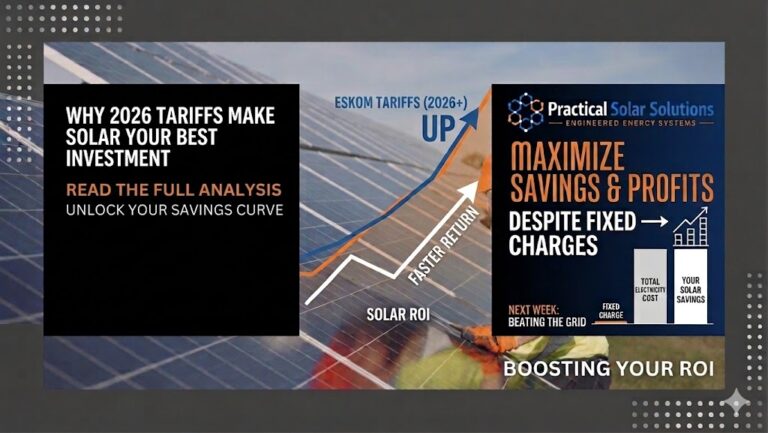
With the full rollout of the 2026/2027 Eskom and municipal tariff adjustments—bringing an average 8.76% to 9.01% hike alongside deep structural re-designs—many operational directors are looking at their utility bills in confusion. You may have noticed that even if you’ve drastically slashed your active energy usage, your fixed network demand, service, and capacity charges look higher than ever.
Business Tech
In the boardrooms and farming unions, a dangerous myth has started to spread: “Eskom’s new capacity charges mean commercial solar isn’t worth it anymore.”
Let’s dismantle that myth right now. The reality is exactly the opposite. For business and agricultural operations, these new capacity charges make an intelligent, engineered hybrid solar system your single greatest operational hedge.
The Shift: Moving from Volumetric to Capacity Billing
Historically, businesses focused entirely on reducing their active volumetric consumption (the variable R/kWh rate). Eskom and major metros have adapted to this by moving the goalposts. Under the revised Retail Tariff Plan (ERTSA) structures, utilities are recovering a much higher percentage of their revenue up front through:
- Network Demand Charges (kVA): Billed on your peak draw from the grid, regardless of total energy consumed.
- Generation Capacity Charges (GCC): Fixed structural fees designed to maintain grid connection availability.
If your business installed an unmonitored, basic grid-tied system that only offsets daytime baseload without managing your peak demand spikes, you are exposed to these charges. But that isn’t a solar problem—that’s a system design problem.
How Smart Commercial Solar Crushes the New Tariffs
To beat a tariff structure designed to penalize basic grid-tied setups, smart businesses are pivoting to high-performance, dynamic asset management.
1. Advanced Peak Shaving (Taming the kVA Monster)
Fixed demand charges are calculated based on your highest point of grid consumption in a billing cycle. If your cold storage fans, manufacturing presses, or irrigation pumps all kick in simultaneously on a cloudy morning, your kVA demand spikes, locking in a massive charge for the entire month.
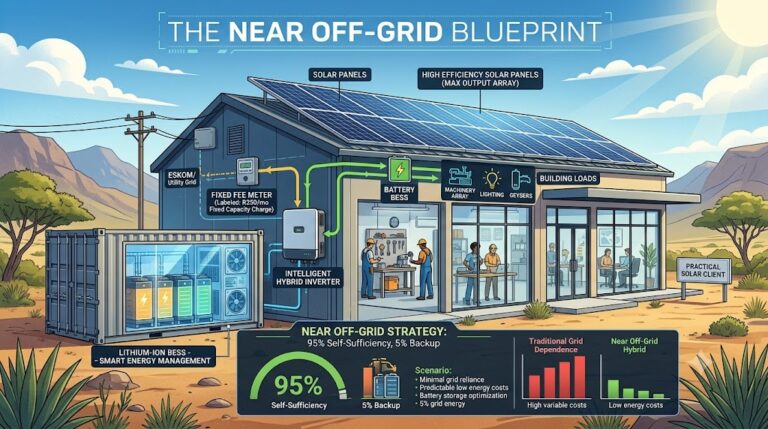
By integrating smart hybrid commercial inverters with containerized lithium storage, your system can engage in automated peak shaving. The moment your facility’s energy demand threatens to cross a specific threshold, the system seamlessly injects stored battery power to smooth out the spike.
The Bottom Line: You legally artificially lower your maximum demand profile, actively forcing your fixed kVA charges down into a lower bracket.
2. Maximizing Time-of-Use (ToU) Arbitrage
Under large-power urban and rural tariffs (like Megaflex or Ruraflex), the gap between standard off-peak rates and High-Demand Peak periods is wider than ever.
[Morning Peak Rates] —> Draw from Lithium Battery Storage (Grid Disconnected)
[Midday Standard] —> Power Facility directly from Solar + Recharge Batteries
[Evening Peak Rates] —> Run Operations from Stored Solar Reserves
A properly sized solar array combined with intelligent energy management software allows your business to run entirely on free, self-generated solar and stored power during the most punitive peak pricing windows, reserving grid usage strictly for cheap, late-night off-peak hours.
Commercial vs. Agricultural: Where the Value Sits
| Sector | Core Operational Vulnerability | The 2026 Solar Financial Fix |
| Commercial / Retail | High daytime cooling loads, lighting, and fixed administrative capacity overheads. | Immediate OpEx Relief: Direct alignment between peak solar generation hours and peak operational business hours yields instant cash-flow deflection. |
| Agricultural / Irrigation | High-power seasonal pumping, cold-chain refrigeration, and remote rural infrastructure line fees. | Demand Smoothing: High-capacity hybrid systems manage heavy motor startup currents, minimizing line-drop penalties and stabilizing localized rural grid faults. |
Property Equity & Tax Advantages (The Unspoken ROI)
Beyond the monthly utility bill, commercial solar investment remains an elite balance-sheet optimization tool:
- Immediate Property Appreciation: Commercial properties featuring independent energy security, grid compliance, and lower operational overheads command a 4% to 8% premium in asset valuation and significantly higher tenant retention rates.
- Asset Depreciation: Accelerating the write-off of solar power production assets against your corporate tax liability provides an immediate injection of working capital back into your cash flow within year one.
The Verdict
Eskom’s structural tariff adjustments aren’t an argument against solar—they are the ultimate proof that the old utility model is dead. They are raising fixed barriers because decentralized, consumer-owned generation is vastly more efficient.
For South African businesses and agricultural enterprises, standing still is the only true financial risk. Moving to an engineered, high-consumption solar strategy transforms an escalating operational liability into a highly predictable, productive corporate asset.