WEEK 3: The “Near Off-Grid” Blueprint: How to Minimize Grid Reliance Safely
By Practical Solar
27 June 2026
Escaping the Grid Legally: The Near Off-Grid Strategy for SA Businesses and Homes
Over the last two weeks, we’ve broken down Eskom’s 2026 tariff structures and shown how intelligent battery arbitrage allows you to dodge premium Time-of-Use rates. But as fixed capacity charges continue to climb just for holding a grid connection, a new question is dominating boardrooms and kitchen tables across South Africa:
“Why don’t I just cut the blue cord completely and go 100% off-grid?”
It’s an attractive thought. However, going completely off-grid requires massive, capital-heavy over-sizing of your solar array and battery bank just to survive three consecutive days of heavy summer rain.
There is a far smarter, more financially viable middle ground: the Near Off-Grid Hybrid Strategy.
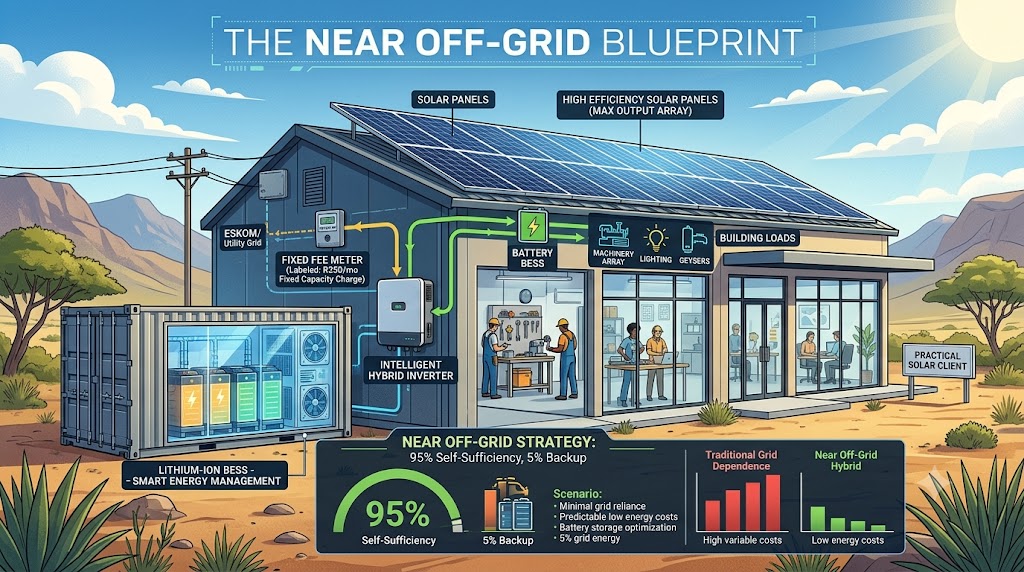
The Near Off-Grid Philosophy: 95% Freedom, 5% Insurance
A Near Off-Grid system is engineered to slash your annual utility consumption by 80% to 95%, while keeping the grid tied to your property strictly as a low-cost backup mechanism.
Instead of spending an extra R150,000 on redundant batteries and panels that you’ll only need during a rare week of terrible weather, you let the grid act as your ultimate safety net.
Here is how a high-performance, engineering-first hybrid setup executes this strategy:
- Priority 1: Pure Solar Self-Consumption: During daylight hours, your panels directly run your heavy operational loads (like agricultural pumps, commercial machinery, or residential geysers).
- Priority 2: Strategic Storage: Excess generation is funneled into high-cycle lithium-ion batteries, sized precisely to carry your base load through the evening and morning peak tariff windows.
- Priority 3: The Automated Grid Safety Net: If prolonged bad weather depletes your storage, a smart hybrid inverter automatically draws a minimal, controlled top-up from the utility—never letting your operations or home go dark.
The Reality Check: Going 100% off-grid means you must size your system for the worst-case winter weather scenario. A Near Off-Grid hybrid system is sized for your optimal daily profile, using the grid as a cheap insurance policy rather than a primary power source.
Outsmarting Fixed Fees with Premium Engineering
With Eskom’s Homepower and commercial structures pushing up fixed infrastructure costs to ensure grid-tied users contribute to network upkeep, your engineering strategy must adapt. Since you cannot avoid the baseline connection fee, the mission is to ensure you never pay a single cent more than that unavoidable base rate.
For industrial, commercial, and agricultural users, a Near Off-Grid blueprint unlocks an extra financial lever: Peak Shaving and Capacity Downgrading.
By programming a high-end hybrid inverter to utilize battery power whenever your equipment creates a massive temporary demand spike, you flatline your grid profile. This allows you to formally apply to your municipality or Eskom to downgrade your supply capacity size (kVA allocation). Because fixed charges are tiered based on connection size, downgrading your connection category directly forces your monthly fixed utility costs into a lower bracket.
The Bottom Line: True Energy Independence is Controlled
True energy security isn’t about radically ripping out wires; it’s about controlling exactly who gets your hard-earned rands. By implementing a Near Off-Grid hybrid setup, you insulate your property from utility inflation, protect your operational budget, and reduce your vulnerability to tariff structural shifts to almost zero.
You keep the grid on your terms—using it only when it benefits you, not them.
Ready to see what a Near Off-Grid blueprint looks like for your facility? Contact Practical Solar Solutions today. Our specialized engineering team will audit your load profile and design a system meant to deliver maximum autonomy.